Atal Pension Yojana in India Explained: Pension Benefits, Contribution & Eligibility (2026 Guide)



Atal Pension Yojana in India Explained: Simple Guide for Guaranteed Retirement Pension
Atal Pension Yojana in India Explained: Pension Benefits, Contribution & Eligibility (2026 Guide)
Learn how Atal Pension Yojana (APY) works in India with simple examples. Understand pension amounts, contribution chart, eligibility, tax benefits, and retirement planning.
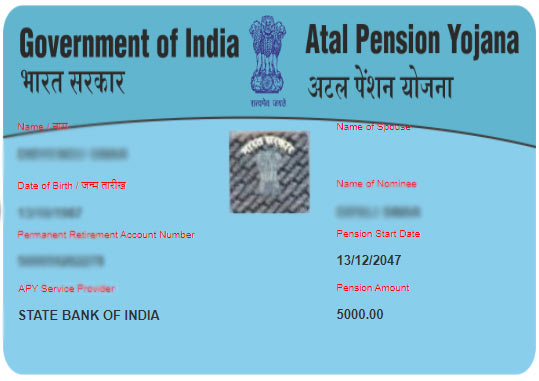
Atal Pension Yojana APY passbook India savings example
Atal Pension Yojana enrollment form bank branch India
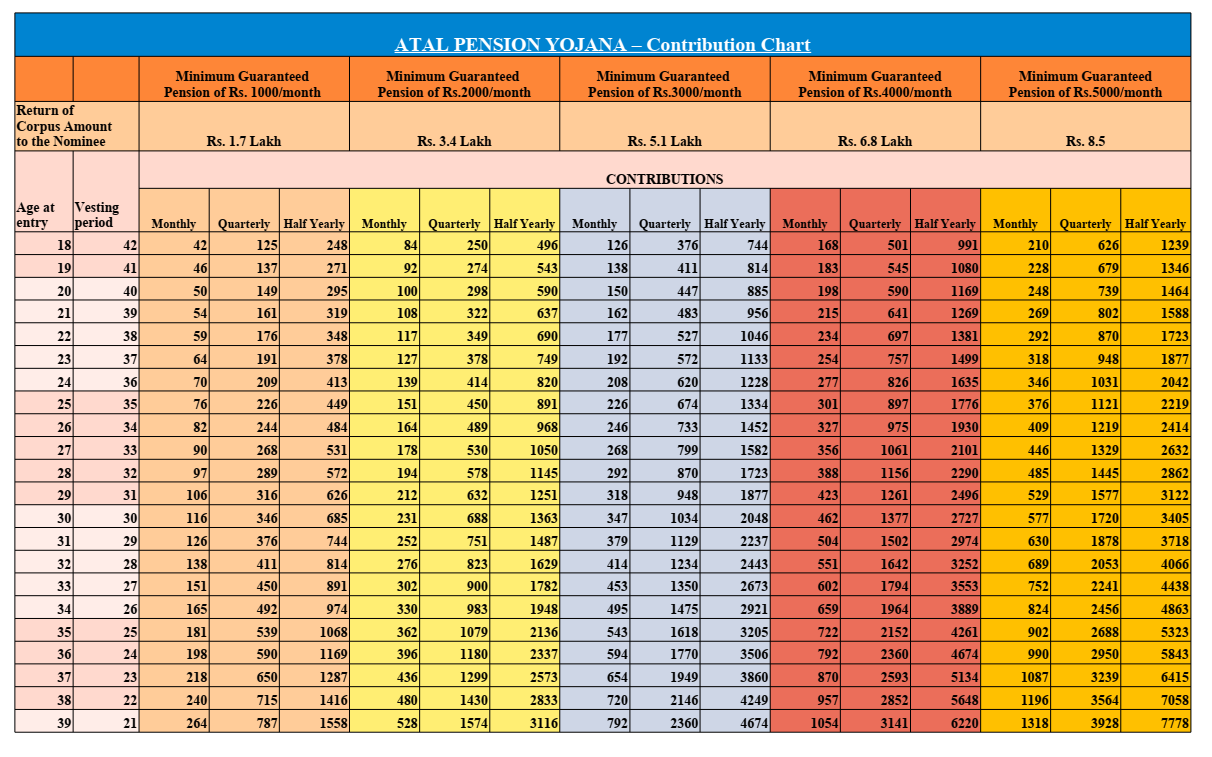
APY pension contribution chart age wise India infographic
Indian worker checking Atal Pension Yojana balance mobile app
Atal Pension Yojana account opening process India bank
For many Indian citizens—daily wage workers, shopkeepers, drivers, helpers, and small business owners—retirement planning feels like a luxury.
Most people think:
“I will work as long as I can.”
“Who will support me after 60?”
“I don’t have EPF or pension.”
To solve this problem, the government introduced a simple scheme:
👉 Atal Pension Yojana (APY)
In this article, we will explain Atal Pension Yojana in India in a simple, practical, and friendly way, using real Indian examples.
No complex pension language. Only clear understanding.
What Is Atal Pension Yojana? (In Simple Words)
Atal Pension Yojana (APY) is a government-backed pension scheme.
Its purpose is:
✅ Give fixed monthly pension after 60
✅ Support unorganized workers
✅ Encourage long-term savings
✅ Reduce old-age dependency
In short:
👉 APY = Guaranteed pension for common Indians
It is regulated by:
👉 Pension Fund Regulatory and Development Authority (PFRDA)
Who Can Join Atal Pension Yojana?
You can open APY account if:
✅ Age is between 18 and 40 years
✅ You have a savings bank account
✅ You are an Indian citizen
Best suited for:
Drivers
Vendors
Farmers
Domestic workers
Small shop owners
Self-employed people
People without EPF/NPS benefit most.
Main Features of APY
| Feature | Details |
|---|---|
| Scheme Type | Government Pension |
| Entry Age | 18–40 Years |
| Pension Age | 60 Years |
| Pension Amount | ₹1k to ₹5k per month |
| Contribution Period | Till 60 |
| Risk | Very Low |
| Guarantee | Yes |
| Nominee Benefit | Yes |
APY gives fixed pension for life.
Pension Options Under APY
You can choose how much pension you want after 60.
| Monthly Pension | Who Should Choose |
|---|---|
| ₹1,000 | Very low income |
| ₹2,000 | Small traders |
| ₹3,000 | Self-employed |
| ₹4,000 | Stable earners |
| ₹5,000 | Young earners |
Higher pension = Higher contribution.
How APY Works (Step-by-Step)
Let’s understand simply.
Step 1: Open APY Account
Visit your bank branch and apply.
Your bank links APY to your savings account.
Step 2: Choose Pension Amount
Select ₹1k–₹5k pension.
Bank calculates monthly contribution.
Step 3: Monthly Auto-Debit
Money is automatically deducted every month.
No need to remember.
Step 4: Continue Till 60
You keep contributing till age 60.
Step 5: Get Pension
After 60:
👉 Monthly pension starts for life.
After your death, spouse gets pension.
Contribution Chart (Simple Example)
Contribution depends on:
Your age
Chosen pension
Example: ₹5,000 Pension Plan
| Entry Age | Monthly Contribution |
|---|---|
| 20 Years | ₹210 approx |
| 25 Years | ₹315 approx |
| 30 Years | ₹577 approx |
| 35 Years | ₹902 approx |
| 40 Years | ₹1,454 approx |
Earlier you join = Less you pay.
Chart: APY Working Flow
Open Account (18–40)
        ↓
Monthly Contribution
        ↓
Auto Debit
        ↓
Continue Till 60
        ↓
Lifetime Pension
Simple and systematic.
Calculation Example: Real Indian Case
Case: Raju (Auto Driver, Indore)
Age: 25
Chosen Pension: ₹3,000
Monthly Contribution: ₹181 (approx)
Contribution Period: 35 years
Total Contribution:
₹181 × 12 × 35 ≈ ₹76,000
After 60:
👉 Gets ₹3,000/month = ₹36,000/year
For life.
Raju invests little, gets lifelong income.
Case: Sunita (Tailor, Patna)
Age: 35
Pension: ₹5,000
Contribution: ₹902/month
After 60:
👉 ₹5,000 every month
Helps in medicines and bills.
APY vs NPS vs PPF
| Feature | APY | NPS | PPF |
|---|---|---|---|
| Pension | Fixed | Market-based | No |
| Risk | Very Low | Medium | Very Low |
| Entry Age | 18–40 | 18–70 | All |
| Lock-in | Till 60 | Till 60 | 15 Years |
| Suitable For | Informal Workers | Salaried/Self | All |
👉 APY = Guarantee
👉 NPS = Growth
👉 PPF = Safety
👉 Related Read:
Internal Link: NPS Scheme in India Explained
https://marketmeterab.blogspot.com/nps-scheme-india
Government Co-Contribution (Earlier Benefit)
Earlier, government contributed for some subscribers (2015–2019). Now, new accounts do not get this.
Still, APY remains very useful.
Tax Benefits in APY
APY qualifies under:
👉 Section 80CCD (part of 80C limit)
Benefit:
Contribution up to ₹1.5 lakh is deductible
Pension received is taxable as per slab.
👉 Related Read:
Internal Link: Mutual Fund Taxation in India
https://marketmeterab.blogspot.com/mutual-fund-taxation-india
Withdrawal Rules in APY
After 60 (Normal Exit)
Full pension starts
Before 60 (Exit)
Allowed only in:
Death
Serious illness
Otherwise, exit is discouraged.
APY is meant for long-term discipline.
Nomination and Family Benefit
APY protects family.
If subscriber dies:
✔ Spouse gets pension
✔ After spouse, nominee gets corpus
Always update nominee details.
Who Should Choose APY?
APY is best for:
✅ Low-income workers
✅ Informal sector employees
✅ People without EPF/NPS
✅ Risk-averse citizens
✅ Young earners
Not ideal for:
❌ High-income professionals
❌ Investors seeking high returns
Best Strategy for Common Indians
Smart planning:
| Tool | Purpose |
|---|---|
| APY | Guaranteed Pension |
| PPF | Safety |
| SIP | Growth |
Example:
APY: ₹300/month
SIP: ₹2,000/month
PPF: ₹30,000/year
Balanced future.
👉 Related Read:
Internal Link: Long Term vs Short Term Investing
https://marketmeterab.blogspot.com/long-term-vs-short-term-investing
How to Open APY Account
You can open APY in:
✅ Any nationalized bank
✅ Private banks
✅ Regional rural banks
Documents Required
Aadhaar
Mobile number
Bank passbook
Steps
1️⃣ Visit bank
2️⃣ Fill APY form
3️⃣ Choose pension
4️⃣ Submit documents
5️⃣ Activate auto-debit
Takes 15–30 minutes.
Common Mistakes Indians Make in APY
Joining late (after 35)
Missing balance in bank
Choosing very low pension
Not updating nominee
Stopping contributions
Avoid these.
Safety of Atal Pension Yojana
APY is backed by Government of India.
So:
✔ No market risk
✔ No company risk
✔ No default risk
It is among the safest pension schemes.
Role of Market Regulator
While APY is regulated by PFRDA, market investments are supervised by:
👉 Securities and Exchange Board of India
So, overall investor system is protected.
Statutory Disclaimer
Atal Pension Yojana rules, pension amounts, and tax benefits are subject to change as per Government of India and PFRDA guidelines. This article is for educational purposes only and does not constitute financial advice. Investors should assess their financial needs and consult a qualified advisor before joining any scheme.
Frequently Asked Questions (FAQ)
Q1. Is APY guaranteed?
Yes. Pension amount is guaranteed.
Q2. Can I change pension amount later?
Yes, once in a year (subject to rules).
Q3. Is APY better than NPS?
For guarantee, yes. For growth, NPS is better.
Q4. Can salaried people join APY?
Yes, if eligible by age and not covered by statutory pension.
Q5. What if I miss payment?
Penalty is charged. Keep bank balance.
Useful Video & Image Resources
APY Explained in Hindi:
https://www.youtube.com/watch?v=F8M2Q9L7X4AAtal Pension Yojana Guide:
https://www.youtube.com/watch?v=K9F3L2M8X7Q
Bibliography
PFRDA Annual Reports
Ministry of Finance Notifications
APY Scheme Guidelines
Income Tax Act – Section 80CCD
RBI Financial Stability Reports
Suggested Internal Links for MarketMeterAB
Senior Citizen Saving Scheme Explained
https://marketmeterab.blogspot.com/senior-citizen-saving-schemeEPF vs PPF Difference Explained
https://marketmeterab.blogspot.com/epf-vs-ppf-differenceNPS Scheme in India Explained
https://marketmeterab.blogspot.com/nps-scheme-indiaPPF in India Explained
https://marketmeterab.blogspot.com/ppf-india-explainedHow Dividends Work in India
https://marketmeterab.blogspot.com/how-dividends-work
Final Words
Atal Pension Yojana is not about big money.
It is about:
✅ Dignity in old age
✅ Regular income
✅ Independence
✅ Peace of mind
If you or someone in your family works in the informal sector, APY is a gift.
👉 Remember: A small saving today can protect your tomorrow. Start early. Stay regular.

Comments
Post a Comment