Charges in Stock Trading Explained for India: Brokerage, Taxes & Hidden Costs (Beginner Guide)

Charges in Stock Trading Explained for India: Simple Guide for Common Citizens
Charges in Stock Trading Explained for India: Brokerage, Taxes & Hidden Costs (Beginner Guide)
Understand all charges in stock trading in India like brokerage, STT, GST, SEBI fees, and DP charges with simple examples. Beginner-friendly guide.
Stock trading charges India brokerage tax breakdown chart
Indian stock market trading charges explained infographic
NSE BSE brokerage charges calculation example India
Intraday vs delivery trading charges India comparison
Demat account DP charges GST STT SEBI fees India
Many Indian investors focus only on profit and loss. But very few people ask an important question:
“How much money is silently going away as charges in stock trading?”
Later, when profits look smaller than expected, people get confused.
The truth is simple:
👉 Stock trading in India involves multiple small charges.
👉 If you don’t understand them, your returns reduce quietly.
In this article, we will explain charges in stock trading in India in a simple, practical, and friendly manner, using real Indian examples that everyone can understand.
No complex accounting terms. Just clear explanation.
Why Understanding Trading Charges Is Important
Knowing trading charges helps you:
✅ Calculate real profit
✅ Avoid unnecessary trading
✅ Choose right broker
✅ Plan long-term investing
✅ Reduce emotional stress
Even a small charge repeated many times can eat big money.
Who Decides Stock Trading Charges in India?
Stock trading charges are governed by:
Securities and Exchange Board of India (SEBI)
National Stock Exchange of India (NSE)
Bombay Stock Exchange (BSE)
Brokers add their own brokerage charges.
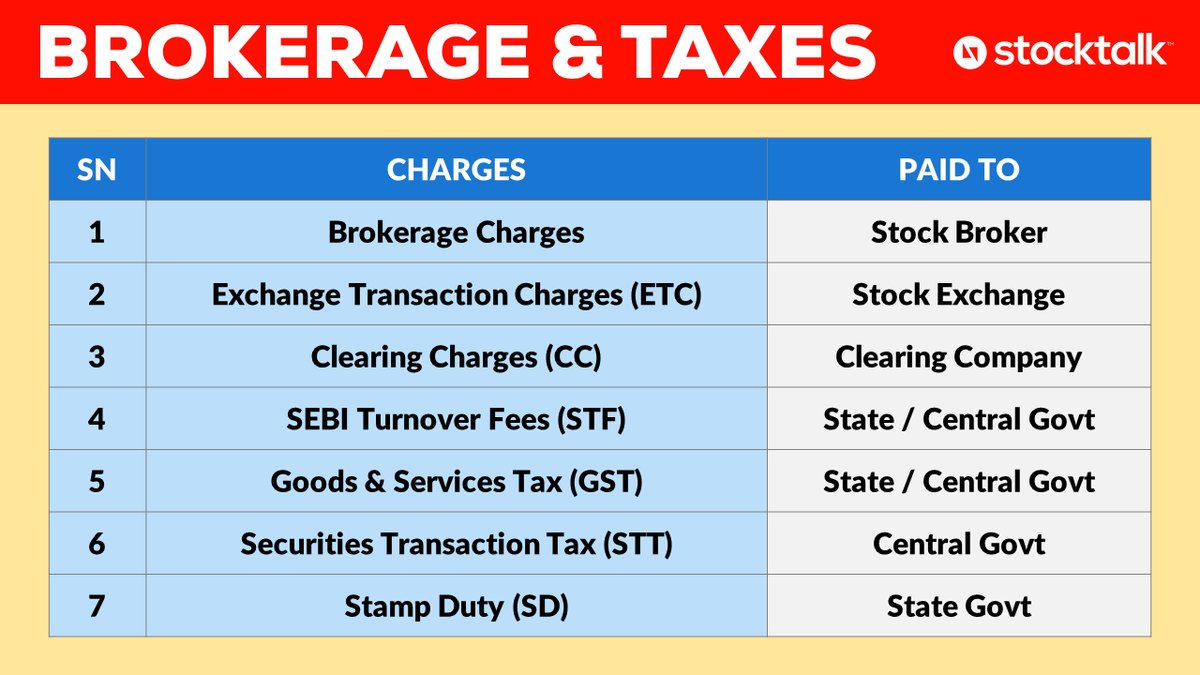
Big Picture: Types of Charges in Stock Trading
Whenever you buy or sell shares, these charges may apply:
Brokerage
Securities Transaction Tax (STT)
Exchange Transaction Charges
SEBI Turnover Fees
GST
Let us understand each one clearly.
1️⃣ Brokerage Charges (Most Discussed)
What Is Brokerage?
Brokerage is the fee charged by your broker for executing your trade.
How Brokerage Is Charged
| Trade Type | Brokerage Style |
|---|---|
| Delivery | % of trade value or zero |
| Intraday | Flat or % |
| F&O | Flat per order |
Example (Delivery Trade)
Ravi buys shares worth ₹20,000.
Brokerage @0.3%:
👉 Brokerage = ₹60
Some brokers offer zero brokerage for delivery trades.
2️⃣ Securities Transaction Tax (STT)
What Is STT?
STT is a government tax charged on share transactions.
You cannot avoid it.
STT Rates (Equity)
| Transaction | STT |
|---|---|
| Delivery Buy | Nil |
| Delivery Sell | 0.1% |
| Intraday Sell | 0.025% |
Example
You sell shares worth ₹50,000 (delivery).
STT = ₹50
3️⃣ Exchange Transaction Charges
These are charged by NSE or BSE.
Very small, but applicable on every trade.
Typical Rate
👉 Around 0.003% – 0.004%
Example
Trade value = ₹1,00,000
Exchange charge ≈ ₹3–4
4️⃣ SEBI Turnover Fees
SEBI charges a tiny fee to regulate markets.
Rate
👉 ₹10 per ₹1 crore turnover
Example
On ₹1 lakh trade:
SEBI fee ≈ ₹0.10
Small, but mandatory.
5️⃣ GST (Goods and Services Tax)
GST is charged on:
Brokerage
Exchange charges
SEBI fees
GST Rate
👉 18%
Example
If total charges = ₹100
GST = ₹18
GST is not charged on STT or stamp duty.
6️⃣ Stamp Duty
Stamp duty is charged by state government.
It is charged only on buy side.
Approx Rates (Equity)
| Type | Stamp Duty |
|---|---|
| Delivery | ~0.015% |
| Intraday | ~0.003% |
Example
Buy shares worth ₹20,000:
Stamp duty ≈ ₹3
7️⃣ DP (Depository Participant) Charges
DP charges are applied when:
👉 Shares move out of your Demat account (on sell).
Typical DP Charge
👉 ₹10 – ₹15 per sell order + GST
This is fixed, not percentage-based.
Chart: Complete Trading Charges Breakdown
Trade Value
   ↓
Brokerage
   ↓
STT
   ↓
Exchange Charges
   ↓
SEBI Fees
   ↓
GST
   ↓
Stamp Duty
   ↓
DP Charges (on sell)
All these together reduce your profit.
Delivery Trading Charges (Example)
Case: Ankit (Long-Term Investor)
Buys shares worth ₹30,000
Sells after 1 year at ₹40,000
Approx Charges
| Charge | Amount |
|---|---|
| Brokerage | ₹0 – ₹90 |
| STT | ₹40 |
| Exchange + SEBI | ₹3 |
| GST | ₹15 |
| Stamp Duty | ₹5 |
| DP Charges | ₹15 |
| Total | ₹78 – ₹150 |
Charges are reasonable for long-term investors.
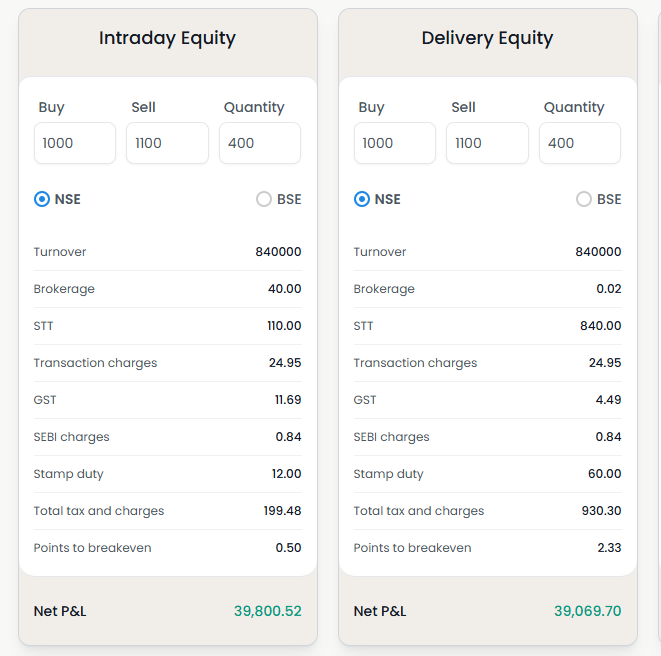
Intraday Trading Charges (Example)
Case: Mohan (Intraday Trader)
Buys and sells ₹50,000 same day
| Charge | Amount |
|---|---|
| Brokerage | ₹20 |
| STT | ₹12.50 |
| Exchange Charges | ₹2 |
| SEBI Fees | ₹0.05 |
| GST | ₹4 |
| Stamp Duty | ₹1.5 |
| Total | ₹40+ |
👉 Frequent trading = higher charges.
Intraday vs Delivery Charges Comparison
| Feature | Delivery | Intraday |
|---|---|---|
| Brokerage | Low / Zero | Charged |
| STT | Only on Sell | Only on Sell |
| Risk | Lower | High |
| Charges Impact | Low | High |
| Suitable For | Investors | Traders |
Hidden Cost Most Indians Ignore
Overtrading
Even if charges are small:
👉 Too many trades = Big loss
Example:
₹50 charge × 20 trades/month = ₹1,000/month
₹12,000/year wasted.
How to Reduce Trading Charges (Legal Ways)
1️⃣ Prefer Delivery & SIP
Less trading = less charges.
2️⃣ Avoid Intraday if Beginner
Charges + risk are high.
3️⃣ Choose Right Broker
Low-cost brokers save money.
4️⃣ Trade Less, Invest More
Best strategy for Indians.
5️⃣ Track Contract Notes
Always check charges after trade.
Charges in Mutual Funds vs Stocks
| Feature | Stocks | Mutual Funds |
|---|---|---|
| Brokerage | Yes | No |
| STT | Yes | Yes |
| Expense Ratio | No | Yes |
| Trading Charges | High | Low |
| Suitable | Experts | Beginners |
👉 Beginners should start with mutual funds.
Read:
Internal Link: Best Mutual Funds for Beginners
https://marketmeterab.blogspot.com/best-mutual-funds-india
Stock Trading Charges & Demat Account
Demat account also has costs.
Read:
Internal Link: How to Open Demat Account in India
https://marketmeterab.blogspot.com/how-to-open-demat-account
Stock Trading & Tax Impact
Apart from charges, tax applies on profit.
Read:
Internal Link: Mutual Fund & Stock Market Taxation in India
https://marketmeterab.blogspot.com/mutual-fund-taxation-india
Statutory Disclaimer
Investments in securities markets are subject to market risks. Read all related documents carefully before investing. Past performance is not indicative of future returns. This article is for educational purposes only and does not constitute investment advice. Charges, taxes, and rules may change. Investors should take decisions based on their financial goals and regulations issued by Securities and Exchange Board of India.
Frequently Asked Questions (FAQ)
Q1. Can trading charges be avoided?
No, but they can be minimized.
Q2. Which charge is highest?
Brokerage and STT.
Q3. Are charges same for all brokers?
No. Brokerage varies.
Q4. Do long-term investors pay less?
Yes, much less than traders.
Q5. Is zero brokerage really zero?
Brokerage may be zero, but taxes still apply.
Useful Video & Image Resources
Stock Market Charges Explained (Hindi):
https://www.youtube.com/watch?v=Q7M8L9F2X4ABrokerage vs Taxes Explained:
https://www.youtube.com/watch?v=F4L8Q2Z9M7PNSE Official Charges Page:
https://www.nseindia.com/products-services/equity-market-charges
Bibliography
SEBI Investor Education Portal
NSE & BSE Official Circulars
Broker Contract Notes (India)
Income Tax Act – Capital Gains
AMFI Investor Awareness Material
Suggested Internal Links for MarketMeterAB
What Is Stock Market in India
https://marketmeterab.blogspot.com/what-is-stock-market-indiaHow NSE and BSE Work in India
https://marketmeterab.blogspot.com/how-nse-bse-workWhat Is Sensex and Nifty in India
https://marketmeterab.blogspot.com/what-is-sensex-niftySIP vs Lump Sum Investment
https://marketmeterab.blogspot.com/sip-vs-lumpsum
Final Words
Trading charges are like small leaks in a water tank.
One leak doesn’t matter.
Many leaks empty the tank.
If you:
✅ Understand charges
✅ Trade less
✅ Invest long term
✅ Stay disciplined
Then your money works for you, not for charges.
👉 Remember: Saving charges is equal to earning returns.

Comments
Post a Comment