EPF vs PPF Difference in India Explained: Which Is Better for You? (Beginner Guide 2026)


EPF vs PPF Difference in India Explained: Simple Guide for Safe Retirement Planning
EPF vs PPF Difference in India Explained: Which Is Better for You? (Beginner Guide 2026)
Understand the difference between EPF and PPF in India with simple examples, returns, tax benefits, rules, and calculations. Easy guide for salaried and self-employed citizens.
EPF passbook UAN portal balance check India example
PPF passbook post office bank savings account India
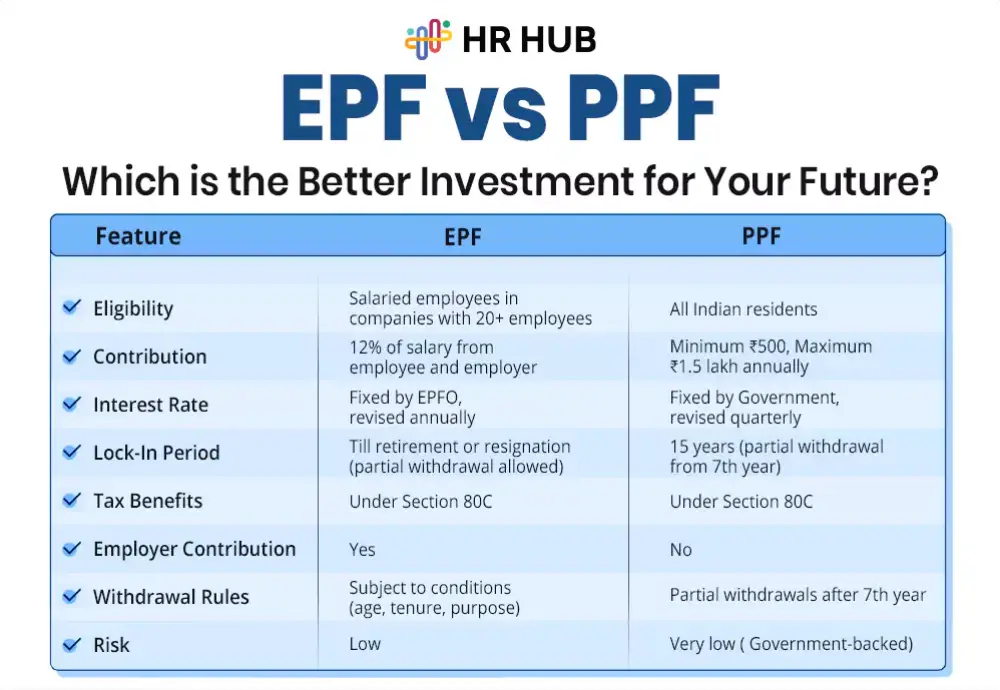
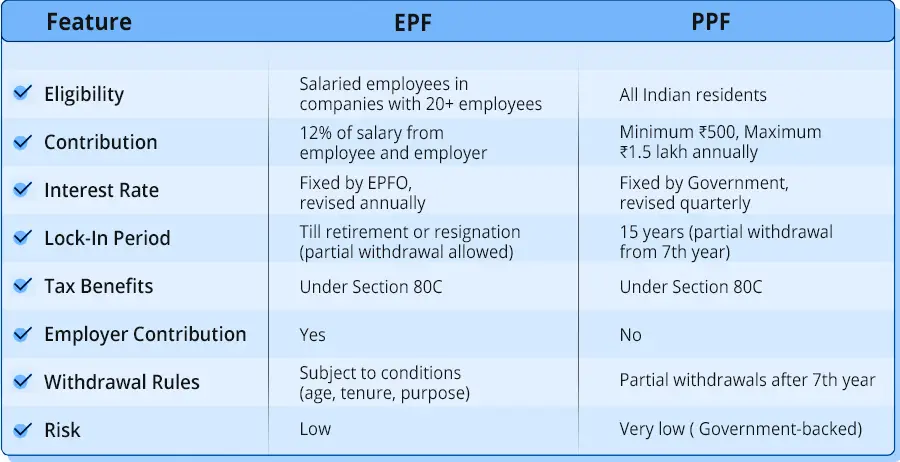
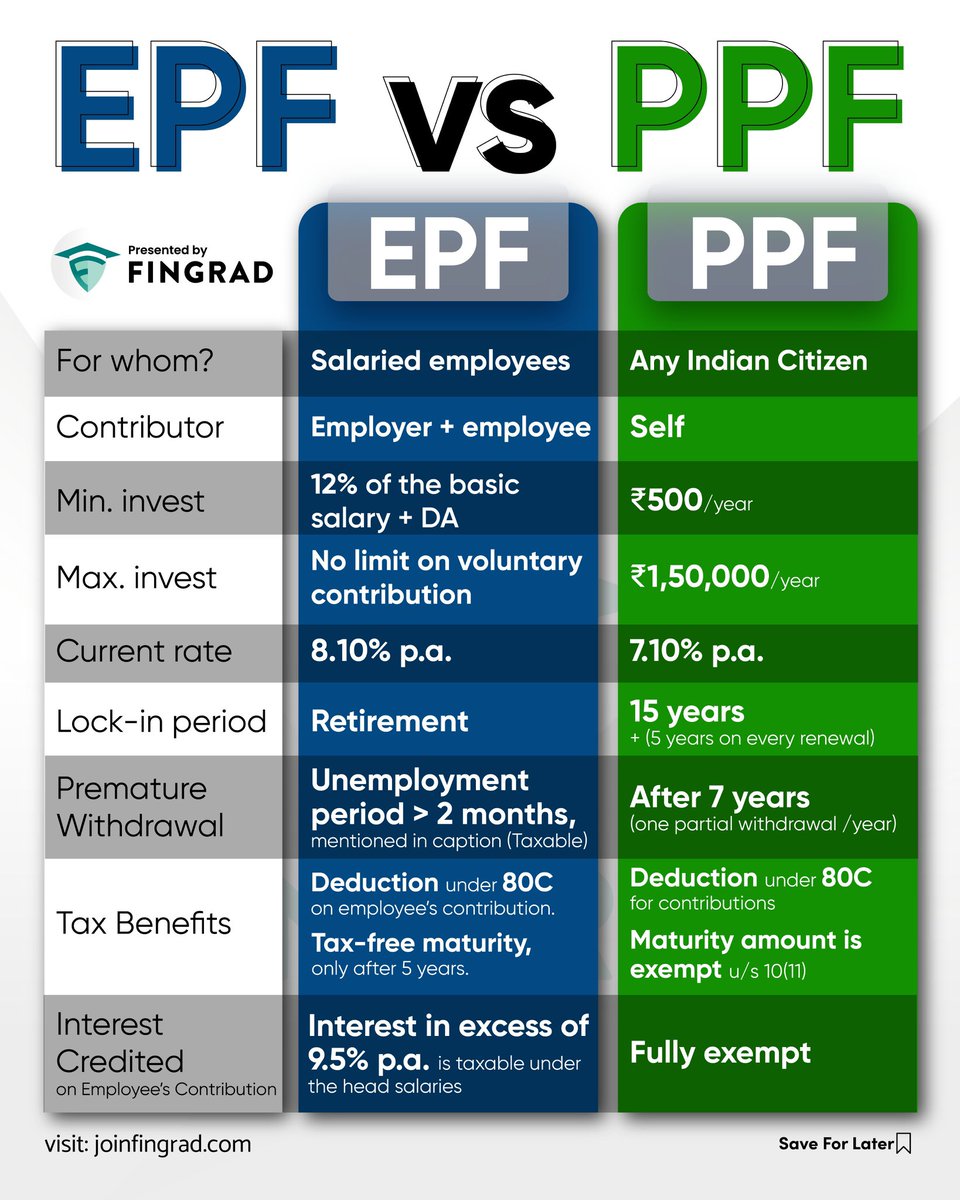
EPF vs PPF comparison chart infographic India
Indian employee checking EPF balance mobile app screen
PPF account opening form India post office bank process
For most Indian citizens, especially salaried employees and middle-class families, one big question comes again and again:
“Should I rely on EPF or PPF for my future?”
“Which one gives better returns and safety?”
Many people invest in both, but very few clearly understand the difference.
So in this article, we will explain EPF vs PPF in India in a simple, practical, and friendly way, using real Indian examples.
No complicated finance terms. Only clear and useful guidance.
What Is EPF? (In Simple Words)
EPF (Employees’ Provident Fund) is a retirement savings scheme for salaried employees.
It is managed by:
👉 Employees' Provident Fund Organisation (EPFO)
If you work in a private company with more than 20 employees, EPF is usually mandatory.
How EPF Works
Every month:
Employee contributes 12% of basic salary
Employer also contributes 12%
Money goes to EPF account
So, savings happen automatically.
Example (EPF)
Rohit earns ₹25,000 basic salary.
His EPF = ₹3,000/month
Employer EPF = ₹3,000/month
Total = ₹6,000/month
Yearly = ₹72,000
Without effort, he saves for retirement.
What Is PPF? (In Simple Words)
PPF (Public Provident Fund) is a voluntary long-term savings scheme.
It is backed by the Government of India and regulated by:
👉 Ministry of Finance (India)
Anyone can open PPF:
✅ Salaried
✅ Self-employed
✅ Business owners
✅ Housewives
✅ Students
You decide how much to invest.
How PPF Works
You invest between ₹500 and ₹1.5 lakh per year
Lock-in: 15 years
Interest: Decided by government
It is fully voluntary.
Example (PPF)
Meena invests ₹1,00,000 every year in PPF.
After 15 years, she builds a big tax-free fund.
EPF vs PPF: Basic Difference Table
| Feature | EPF | PPF |
|---|---|---|
| Who Can Invest | Salaried Employees | All Citizens |
| Contribution | Mandatory | Voluntary |
| Lock-in | Till Job Change/Retirement | 15 Years |
| Max Limit | No Fixed Limit | ₹1.5 Lakh/Year |
| Risk | Very Low | Very Low |
| Control | Employer + EPFO | You |
👉 EPF = Job-linked
👉 PPF = Self-controlled
Interest Rate: EPF vs PPF
Interest rates change every year.
| Scheme | Avg Interest (Approx) |
|---|---|
| EPF | 8% – 8.5% |
| PPF | 7% – 8% |
Both are better than normal savings accounts.
Tax Benefit: EPF vs PPF (EEE Advantage)
Both EPF and PPF follow EEE system:
| Stage | EPF | PPF |
|---|---|---|
| Investment | Tax-Free (80C) | Tax-Free (80C) |
| Interest | Tax-Free | Tax-Free |
| Maturity | Tax-Free* | Tax-Free |
(*Conditions apply for EPF withdrawal.)
This makes both very powerful.
👉 Related Read:
Internal Link: Mutual Fund Taxation in India
https://marketmeterab.blogspot.com/mutual-fund-taxation-india
Withdrawal Rules: EPF vs PPF
EPF Withdrawal
You can withdraw:
✅ After retirement
✅ After job loss (2 months)
✅ For house, marriage, medical, etc.
Partial withdrawals allowed.
PPF Withdrawal
Partial withdrawal after 7 years
Full after 15 years
Extension possible
PPF is stricter.
Chart: Withdrawal Timeline
EPF → Job Change / Emergency / Retirement
PPF → 7 Years (Partial) → 15 Years (Full)
EPF is more flexible.
Calculation Example: EPF vs PPF (15 Years)
Let us compare with real numbers.
Case 1: EPF Investment
Amit’s EPF saving = ₹6,000/month
Yearly = ₹72,000
Interest = 8.25%
Period = 15 Years
👉 Total Invested ≈ ₹10.8 lakh
👉 Maturity Value ≈ ₹25–28 lakh
Case 2: PPF Investment
Rina invests ₹72,000/year in PPF
Interest = 7.5%
Period = 15 Years
👉 Total Invested ≈ ₹10.8 lakh
👉 Maturity Value ≈ ₹19–21 lakh
Result
EPF gives higher return because of employer contribution.
EPF vs PPF: Risk and Safety
| Factor | EPF | PPF |
|---|---|---|
| Government Support | Yes | Yes |
| Market Risk | No | No |
| Default Risk | Very Low | Very Low |
| Stability | High | Very High |
Both are among the safest investments in India.
Who Should Choose EPF?
EPF is best for:
✅ Private sector employees
✅ People who want automatic savings
✅ Those with long-term jobs
✅ Beginners in investing
If you have EPF, never ignore it.
It is free money from employer.
Who Should Choose PPF?
PPF is best for:
✅ Self-employed people
✅ Freelancers
✅ Small business owners
✅ Housewives
✅ Conservative investors
PPF gives full control.
Can You Use Both EPF and PPF? (Best Strategy)
Yes. Smart Indians use both.
Ideal Combination
| Source | Allocation |
|---|---|
| EPF | Mandatory Base |
| PPF | Voluntary Top-Up |
| SIP/Equity | Growth |
This creates:
👉 Safety + Growth + Tax Saving
👉 Related Read:
Internal Link: Long Term vs Short Term Investing
https://marketmeterab.blogspot.com/long-term-vs-short-term-investing
Real-Life Indian Example
Case: Prakash (Sales Executive, Surat)
EPF: ₹5,000/month
PPF: ₹50,000/year
SIP: ₹2,000/month
After 20 years:
EPF Corpus: ₹35+ lakh
PPF Corpus: ₹18+ lakh
SIP Corpus: ₹25+ lakh
Total ≈ ₹78 lakh+
Balanced planning works.
EPF vs PPF vs Mutual Funds
| Feature | EPF | PPF | Mutual Fund |
|---|---|---|---|
| Risk | Very Low | Very Low | Medium |
| Return | Medium | Medium | High (Long Term) |
| Lock-in | Job Based | 15 Years | Flexible |
| Suitable | Salaried | All | Growth Seekers |
👉 For best results: Use all three.
👉 Related Read:
Internal Link: Best SIP Amount for Beginners
https://marketmeterab.blogspot.com/best-sip-amount-india
Common Mistakes Indians Make
Ignoring EPF statements
Not checking UAN balance
Missing PPF yearly deposit
Withdrawing early
Depending only on EPF/PPF
Avoid these mistakes.
How to Check EPF and PPF Balance
EPF
EPFO App
SMS service
PPF
Bank Net Banking
Passbook
Post Office portal
Check once every 3 months.
Role of Market Regulator
While EPF and PPF are government schemes, market investments are regulated by:
👉 Securities and Exchange Board of India (SEBI)
So, your overall financial system is well protected.
Statutory Disclaimer
EPF and PPF rules, interest rates, and tax benefits are subject to change as per Government of India notifications. This article is for educational purposes only and does not constitute financial advice. Investors should assess their financial goals and consult a qualified advisor before making decisions. Market-linked investments are regulated by Securities and Exchange Board of India.
Frequently Asked Questions (FAQ)
Q1. Is EPF better than PPF?
For salaried people, yes. Because of employer contribution.
Q2. Can I invest in both?
Yes. It is recommended.
Q3. Is PPF safer than EPF?
Both are equally safe.
Q4. Can I withdraw EPF anytime?
Only under specific conditions.
Q5. Which is best for retirement?
EPF + PPF + SIP together.
Useful Video & Image Resources
EPF vs PPF Explained (Hindi):
https://www.youtube.com/watch?v=F8Q2M9L7X4AHow EPF Works:
https://www.youtube.com/watch?v=K7M2F9QX4P8EPFO Portal:
https://www.epfindia.gov.in
Bibliography
EPFO Annual Reports
Ministry of Finance Notifications
RBI Financial Stability Reports
Government Savings Scheme Guidelines
Suggested Internal Links for MarketMeterAB
PPF in India Explained with Calculation
https://marketmeterab.blogspot.com/ppf-india-explainedWhat Is Stock Market in India
https://marketmeterab.blogspot.com/what-is-stock-market-indiaHow to Open Demat Account in India
https://marketmeterab.blogspot.com/how-to-open-demat-accountELSS Mutual Funds Explained
https://marketmeterab.blogspot.com/elss-mutual-funds-indiaCharges in Stock Trading Explained
https://marketmeterab.blogspot.com/stock-trading-charges-india
Final Words
EPF and PPF are like two strong pillars of Indian financial life.
EPF gives automatic savings.
PPF gives personal control.
If you use both wisely and add some growth investment, you can build:
👉 A safe, stable, and stress-free future.
Remember: Strong foundation first. High growth later.

Comments
Post a Comment